Concrete Sidewalk and Walkway Contractors in San Marcos
A walkway is small concrete with a big job: it's the first thing people step on and the first place someone trips. We build new front walks and side paths, replace broken sidewalk panels, and fix the lip that catches every delivery driver's toe.
Concrete Sidewalk or Private Walkway? Who Owns the Strip by the Street
There are two different things people call a sidewalk, and the rules depend on which one you have:
| Public sidewalk | Your walkway | |
|---|---|---|
| Where it is | Along the street, usually in the city right-of-way | Drive or street to your door, side yard, out to the shed |
| Who sets the design | City standard detail 432S-1-SM | You and your HOA |
| Permit and inspection | City business | Ask the city case by case |
| ADA ramps at corners | Detail 432S-3-SM | Not required |
| Who pays to fix it | Ask the city first | You |
Sidewalks along a business frontage are covered under commercial concrete.
San Marcos Sidewalk Specs: 5 Feet Wide, 4 Inches Thick
The city's sidewalk detail (432S-1-SM) is a good benchmark for any walk, public or not:
| Width | 5 ft minimum |
|---|---|
| Thickness | 4 in minimum |
| Concrete | 3,000 psi, vibrated in place |
| Base | 2 in sand cushion |
| Steel | One layer of #3 rebar, no more than 18 in on center both ways |
| Cross slope | 1.5% typical, 2% maximum |
| Joints | Control joints ¼ in wide × ¾ in deep; redwood expansion joints at 40 ft maximum |
| Corners | ADA ramps per city detail 432S-3-SM |
Source: City of San Marcos detail 432S-1-SM.
That 2% cross slope limit is about wheelchairs and walkers as much as drainage. A walk that tips more than that sideways is hard to push a chair across, so we set the forms with a level, not by eye.
Concrete Sidewalk Repair: Replace the Panel, Grind the Lip, or Lift It
Sidewalk repair here usually starts with a lifted or dropped edge. Tree roots push panels up; wet clay lets them sink. The fix depends on what the panel is doing. Pick what your walk looks like:
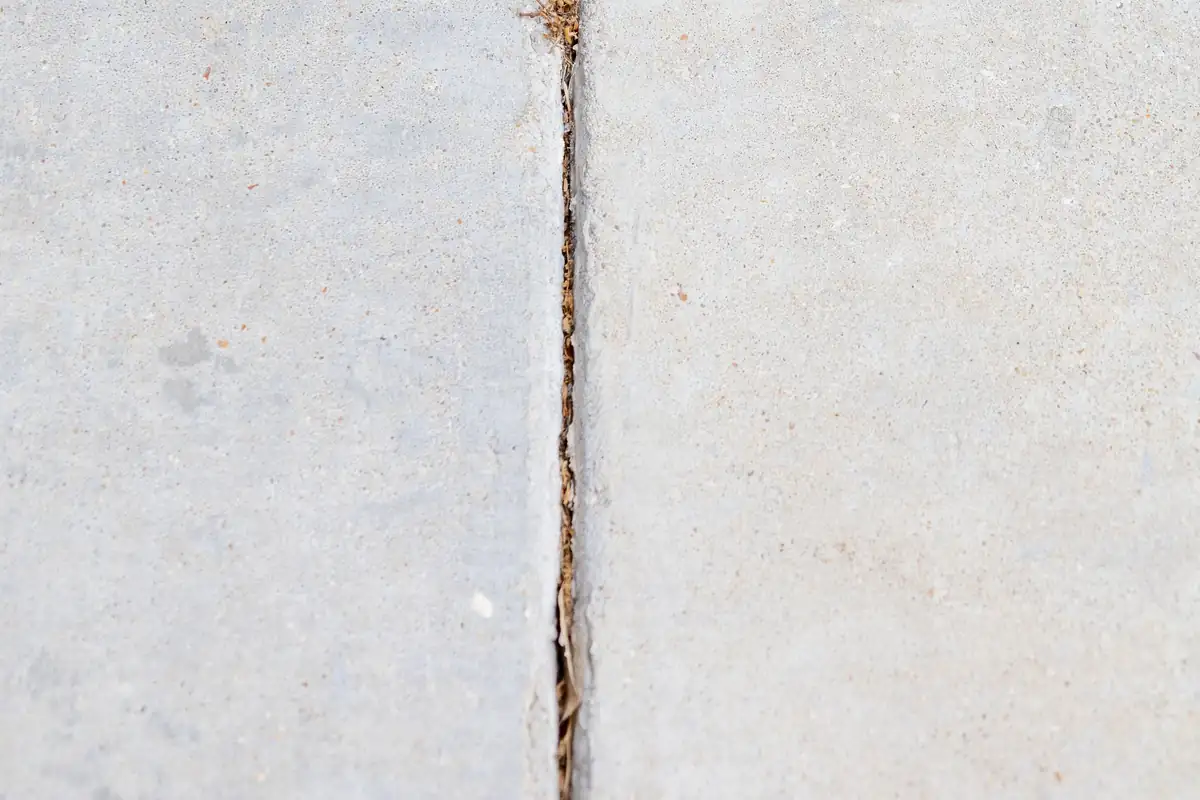
Lip at a joint, panel flat and whole: grind it
Grinding the raised edge down removes the trip without touching the rest of the walk. It's the cheapest fix that actually lasts, as long as the panel has stopped moving.
Sunken walkway panel in one piece: lift or replace
Mudjacking or foam can raise an intact panel back to grade. If it sank because a downspout empties beside it, move the water first or it sinks again.
Cracked into pieces or heaved by a root: replace the panel
Cut it out along the joints, deal with the root, and pour a new panel doweled to its neighbors. Cutting a large root can harm the tree, so on a big shade tree it's worth asking an arborist before the saw comes out.
Hairline cracks with no height change: usually leave it
Shrinkage cracks are normal. Seal one if it's wide enough to let water and dirt in; otherwise it's cosmetic.
A bag of Quikrete patch won't fix a trip hazard. Thin patches feathered over a sunken edge pop loose within a season or two. They're fine for filling a chip, not for rebuilding a height difference. For cracks and spalling beyond walkways, see concrete repair.
Concrete Walkway Layout for Front Entries and Landings
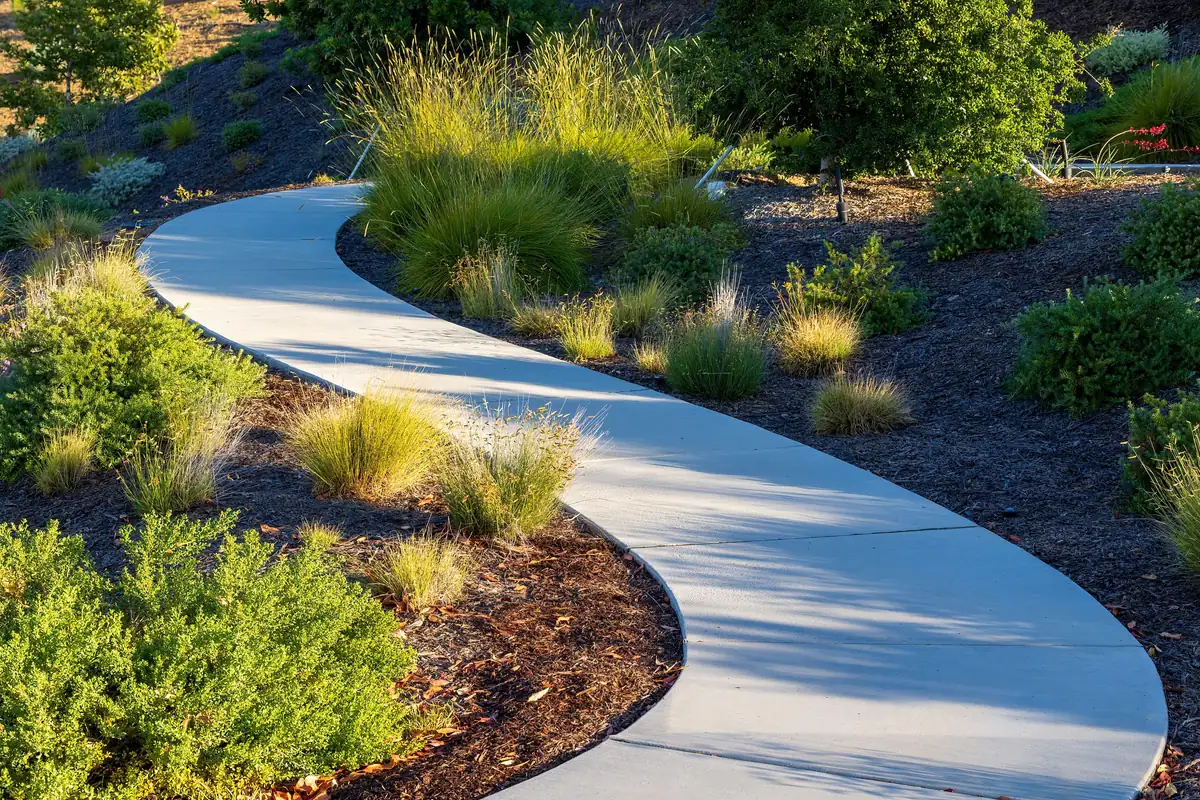
- Curves cost a little more than straight runs because of the forming, and they look better on most lots. Joints on a curved walk are cut so each panel stays roughly square.
- Wider at the door. A landing at the front door gives room to stand while the door swings open. Steps and porch landings are formed separately from the walk and tied to it with dowels.
- Steps: every riser should be the same height. One odd step at the bottom (where the walk meets a sloped yard) is what people trip on.
- Finish: broom for grip. A border or a stamped walkway section can tie in with a patio; see stamped concrete.
- Drainage: a walk across a slope can act like a dam. Give water a way across or around it.
Concrete Sidewalk Installation Cost
| Sidewalk or walkway work | Published range | Source |
|---|---|---|
| New sidewalk, standard finish (national) | $8–$12 per sq ft | HomeAdvisor, June 2026 |
| 4-inch walkway slab (national) | about $6 per sq ft | HomeAdvisor slab guide, June 2026 |
Walkways are small jobs, so the minimum charge for a truck and a crew day matters more than the square-foot number. Adding a walk to a driveway or patio job at the same time is the cheapest way to get it built.
Links: HomeAdvisor sidewalk cost, HomeAdvisor slab cost.
Need more than a walk? Our San Marcos concrete contractor page covers the rest.
Sidewalk and Walkway Questions
Who is responsible for the public sidewalk in front of my house?
Ask the City of San Marcos before you pay anyone to fix a public sidewalk. Cities handle this differently, and we would rather you hear it from Planning & Development Services (512-805-2630) than from a contractor guessing.
Does a new walkway need to be 5 feet wide?
Five feet is the city's minimum for public sidewalks. A private front walk can be narrower, but two people walking side by side and anyone pushing a stroller will thank you for four feet or more.
Can a sunken sidewalk panel be lifted instead of replaced?
Often, yes. Mudjacking and foam lifting raise an intact panel back to grade. HomeAdvisor's June 2026 national ranges are $3 to $6 per square foot for mudjacking and $5 to $25 for foam. A panel that is broken in pieces has to be replaced.
Walkway or sidewalk job?
Tell us whether it's a new walk or a repair, roughly how long, and what's wrong with the old one if there is one.