Retaining Wall Builders for San Marcos Hills and Clay
A retaining wall holds back a lot of weight, and most walls that fail fail the same way: water got behind them with nowhere to go. In San Marcos the soil behind the wall is either Hill Country rock and thin topsoil or Blackland clay that swells when it's wet. Both need the wall built for them. The first question is who designs it.
Retaining Wall Contractors Near Me: When a Wall Needs an Engineer
Short landscape walls that hold a flower bed are simple. Tick anything that describes your wall:
The height that triggers a design depends on the code the city has adopted and on what sits above the wall, so ask the city's Building division what yours needs. We'd rather spend a day on that question than build a wall that has to come down.
Concrete Retaining Wall vs. Block, Timber and Steel
| Wall type | How it works | Lifespan and catch |
|---|---|---|
| Poured concrete retaining wall | Cast-in-place wall with a reinforced footing; steel ties the wall to the footing | Longest-lived and strongest for its thickness. Plain gray unless formed with a texture or faced with stone. |
| Segmental block (Techo-Bloc style) | Dry-stacked interlocking units; taller walls use geogrid layers into the backfill | Flexible, so it tolerates some ground movement. Depends entirely on base and drainage. |
| Large precast block (Redi-Rock style) | Heavy precast units set by machine; mass holds the soil | Fast, tall walls; needs equipment access. |
| Concrete block (CMU) | Mortared block on a footing, cells grouted with rebar | Strong; usually faced with stucco or stone to look finished. |
| Timber or railroad tie | Stacked wood with deadmen anchored back into the slope | Cheapest and shortest-lived; rots where it touches soil. |
| Steel or Corten | Steel plates as edging and short terraces | Clean, modern look for low walls; not for heavy loads. |
| Plastic | Landscape edging panels | For garden borders only, not for retaining real soil. |
We build poured concrete and block walls. If a timber or steel wall is the right answer for your yard, a landscaper is the better hire, and we'll say so.
Poured Concrete Retaining Wall Drainage and Footings
Drainage behind the wall is not optional: clean gravel against the back of the wall, a perforated drain at the bottom that daylights or ties to a drain line, and weep holes on taller poured walls. Filter fabric keeps clay from clogging the gravel.
On clay, the backfill directly behind the wall should be free-draining material rather than the clay that came out of the hole. Wet clay is heavy and it swells; putting it right back behind the wall loads the wall twice.
On limestone, a footing can often bear on rock, which is excellent, but the rock may need cutting to get a level, continuous footing. Texas State's soil survey of Freeman Ranch in Hays County describes the Hill Country soils as "mostly stony" over erosion-resistant limestone, and USDA's Comfort series hits rock 10 to 20 inches down.
Water from above matters too: a swale behind the top of the wall keeps runoff from pouring over or behind it. The 1998 and 2015 floods showed how fast water moves off these slopes; NWS recorded more than 30 inches of rain in 36 hours south of San Marcos in October 1998.
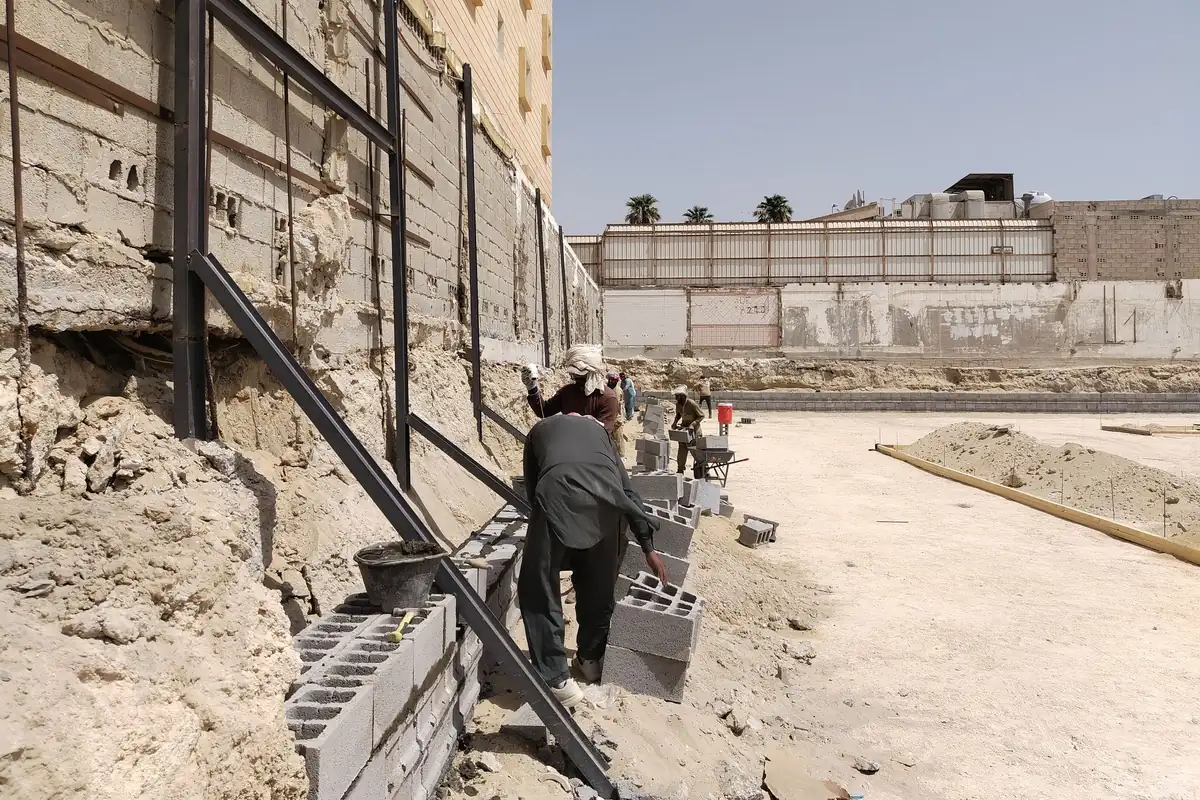
Building a Retaining Wall on a San Marcos Slope
On the hilly side of town, lots often step down toward the street or a creek, and a wall is what makes the yard usable. A few local rules shape those projects:
- Digging on the aquifer. Excavation on the Edwards Aquifer recharge and transition zones requires a qualified geologist or a city inspection, and finding a void or sinkhole stops work within 50 feet until it's evaluated (Development Code §6.3.2).
- Pavement on slopes. Outside the Recharge Zone the code also limits impervious cover on steep ground: 20% on 15–25% slopes and 10% above 25% (Table 6.2). If the wall is there to create a flat spot for a patio or parking pad, that pavement is what the limit affects.
- Creeks. Water quality zones run 25 to 200 feet each side of a waterway's centerline, depending on its size, with more limits in a buffer beyond that.
- HOAs. Walls visible from the street usually need architectural approval, and the committee will ask about material and color.
Source: City of San Marcos Development Code (ORD-2026-08), §6.2–6.3.
Retaining Wall Cost by Material
| Wall material | Published range | Source |
|---|---|---|
| Poured concrete wall | $30–$50 per face sq ft | HomeAdvisor, June 2026 |
| Interlocking segmental block | $15–$35 per face sq ft | Fixr, 2025 |
| Mortared concrete block | $30–$50 per face sq ft | Fixr, 2025 |
| Timber wall | $15–$30 per face sq ft | HomeAdvisor, June 2026 |
| Railroad tie wall | $25–$30 per face sq ft | HomeAdvisor, June 2026 |
The face price leaves out the parts that vary most here: digging in rock, hauling off clay, importing drainage stone and backfill, and engineering. On a hillside lot those can match the cost of the wall itself, which is why we price retaining walls only after seeing the slope.
Links: HomeAdvisor retaining walls, Fixr retaining walls.
A wall often comes with a patio or steps; see what else our concrete contractor crew builds.
Retaining Wall Questions
Why is my old retaining wall leaning?
Almost always water. Soil behind a wall with no drainage gets heavy when it's wet, and clay also swells, so the wall gets pushed harder every rainy season. Leaning walls rarely straighten; plan on rebuilding with drainage.
Is a railroad tie retaining wall a good idea?
It's cheap to build and short-lived. Ties and timber rot where they touch wet soil, and old creosote ties aren't something you want next to a vegetable bed. For anything you want to last, concrete or block is the better spend.
Can a retaining wall go on a property line?
Sometimes, but the footing and drainage stone extend past the face of the wall, and the neighbor's side may be affected. Check your survey, your HOA and the city before designing a wall on or near a line.
Pricing a retaining wall?
Roughly how long and how tall, what it's holding back, and whether anything (a drive, a pool, a building) sits above it.